

AUTHOR INTERVIEW: Matt Francis, author of the 'Murder in the Pacific' series

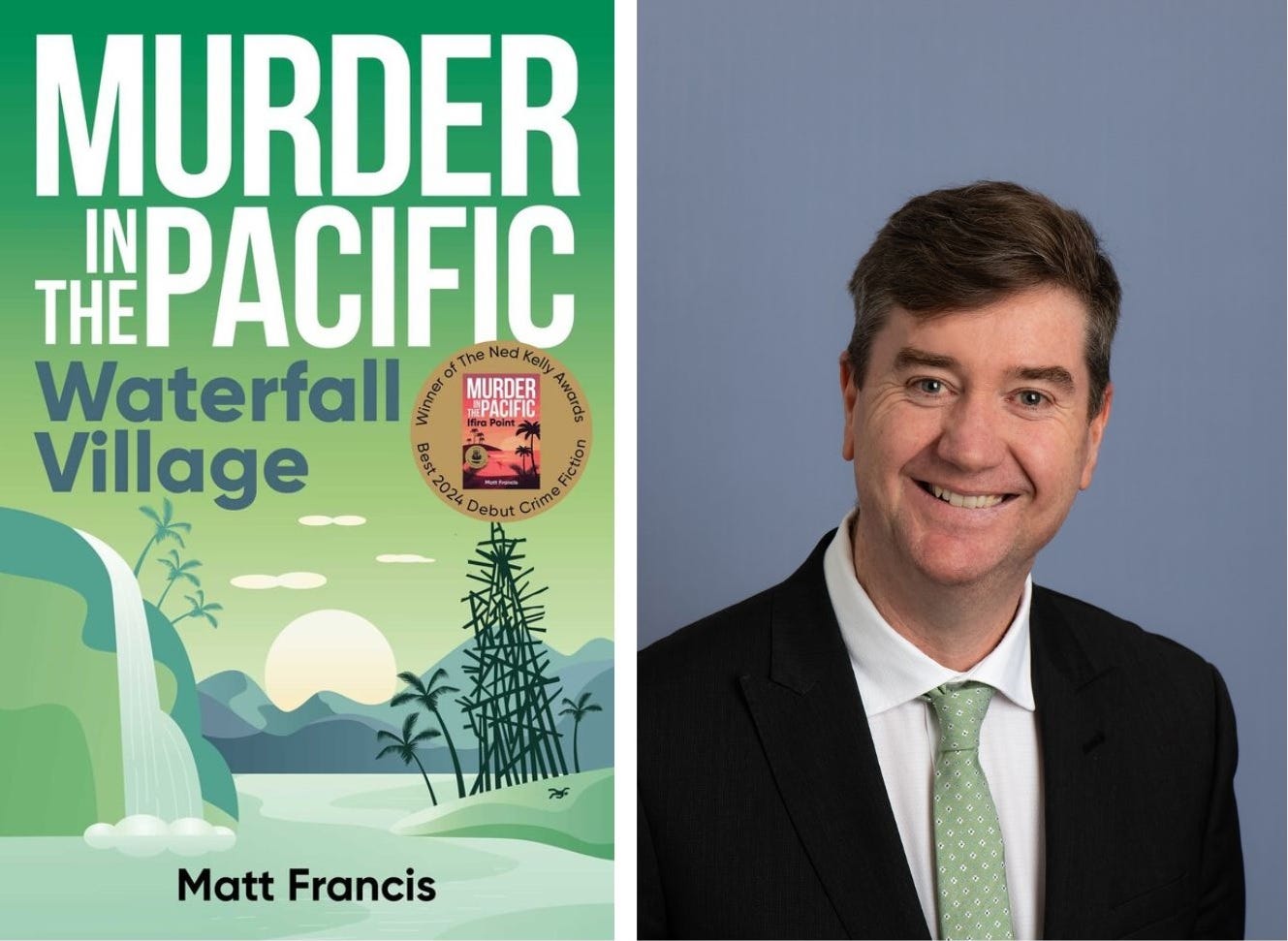
Today I’m pleased to welcome award-winning author, Matt Francis. Murder in the Pacific has quickly become one of my favourite series. Each book is a wonderful blend of likeable characters and intriguing mysteries set across the stunning backdrop of Vanuatu and its unique mix of cultures.
Matt is currently four books into the series with plans for more to come. You can read my reviews for the individual titles here:
I hope you enjoy this interview as much as I did!
Hi Matt. I’m loving this series, especially how it transports the reader to Vanuatu – a place I previously knew little about. You’ve spent two decades researching and writing about the region. What inspired you to start writing fiction? How did the idea for a crime series set in Vanuatu come about?
Thank you, that is very kind and lovely to hear. Yes, I have been undertaking academic research for twenty years in the Pacific region, including Vanuatu. As a result, I have come to know (but not fully understand) its many contradictions. It is said to be one of happiest places on earth, yet domestic and gendered-based violence is high. It is a Christian country, yet kastom is considered even more important to national identity. Vanuatu is also the site for international competition between Australia (and Western allies) and China. So given this, I felt it was ripe for crime novels that wove this unique history and culture into the storyline.
Your first book, Murder in the Pacific: Ifira Point, was a well-deserving winner of the 2024 Ned Kelly Award for Best Debut Crime Fiction. Do you remember the moment when you first heard that you had won? Did winning add any pressure when writing subsequent books in the series?
I was in the US for work when I was notified that I was shortlisted and then soon after received an email letting me know I had won. Both being shortlisted and winning were entirely unexpected – but extraordinarily exciting. I still wonder if it is actually true! Thankfully, I had already written the next two books, so the pressure was not as strong as it might have been.
George and Jayline are such well-developed characters – they feel like my friends after reading four books! They have great chemistry, and I particularly enjoy their banter. How do you approach writing dialogue?
I see both George and Jayline in my mind when I am writing and simply allow them to talk to each other. I probably have some advantage as much of how George sees the world mirrors my own viewpoint – so perhaps Jayline is more a foil to my own thinking. While the books aren’t written in the first-person, they are written from George’s perspective – with only things George can see, hear or perceive being described. This also helps me use Jayline to push things along by making George having to respond to her words.
While writing the series, have any characters or storylines ever surprised you by taking the story in a direction you didn’t originally plan?
Absolutely. I am very much a ‘pantser’ and so have no idea what is going to happen at any given time. I normally start writing on 1 November and commit to 1000 words a day (though this usually speeds up as I get about part-way through the book) which takes just under an hour. When I start writing, I only know which province or island I want George and Jayline to visit (the first six books in the series all feature one of the six provinces of Vanuatu). I don’t know who is going to be murdered, how they are going to be murdered, who will be the murderer nor how George and Jayline will catch them. In book five, I thought the killer was someone else right up to the last 5000 words – it was a complete shock to me when it turned out not to be who I thought it was! As a result, I do occasionally need to go back to ‘correct’ clues, but it is amazing how often the right clues were in place all along.
I love how you blend real societal issues across Vanuatu within the storylines – this was especially prevalent in your latest novel, Waterfall Village. What do you feel are the biggest challenges currently facing Vanuatu?
Vanuatu is a small island developing state and so faces many challenges in providing high quality education, health, economic, and social outcomes for its population. Whilst it has enormous natural resources in the surrounding ocean, it does not have the capacity to take advantage of these resources, nor can it stop other predatory countries doing so. Its small population is dependent on foreign aid but there are levels of corruption that means that it is not always as effective as possible. It is no wonder so many of its younger people travel to Australia and New Zealand to find seasonal work – leaving their families behind with the promise of sending money back. (Local media reports highlight how Ni-Vanuatu workers in Australia are routinely exploited by Australian employers.) Its geography also results in many challenges as it is located on the ‘ring of fires’ so is susceptible to regular earthquakes and active volcano events. Finally, it also seems to be experiencing greater frequency and severity of tropical cyclones. There is no simple solution to any of these issues.
On a somewhat lighter note, the humour is a highlight of the series. Do you think it’s important to balance these lighter moments against the darker elements?
This is very much reflective of how Ni-Vanuatu manage day-to-day. The sound I most associate with Vanuatu is laughter. It is heard everywhere, regardless of the circumstances. No doubt it is in part a coping mechanism, but there is certainly a real love of life that permeates the country. The humour therefore feels natural and what I have experienced when there.
I can’t help but smile whenever Alfred’s decrepit taxivan makes an appearance – it often feels like a character of its own. What is the most harrowing travel experience or journey that you’ve had?
Alfred’s taxivan is not an exaggeration! You can see versions of it everywhere – though there has been an increase in newer vans in recent years. The most harrowing trip was less to do with the condition of the taxivan (which was terrible) but the reason I was in it. We were conducting research looking at standard of living and so undertaking income and expenditure surveys. To ensure the rigour of data collected, we employed local Ni-Vanuatu to recruit survey respondents. As we neared the end of the day and were picking-up the ten local research assistants, we were unable to locate one of them – a young female. It was getting dark and we were slowly driving through a township with a very bad reputation. We were told that one of the houses she had visited had been the site of a knife attack the day before. As night fell, we were all getting very nervous and concerned. I had visions of our young colleague being stabbed and killed. Finally, someone managed to contact her only to be told she had taken the afternoon off and was now back safe and sound at home!
Something else present in each book is George’s love for chocolate milkshakes – I find myself craving them during those scenes! What’s your go-to café order?
In Vila, the best place for a chocolate milkshake is ‘Jill’s Café’ which is on the main street just behind the foreshore. Beautiful views and beautiful milkshakes. Back home, I am much more boring and will probably order just a pot of English Breakfast tea. I am a sucker though for a hedgehog or a choc-iced jam doughnut!
While reading, I’ve continually imagined the series adapted for film or television. Can you tell us about your script writing? Do you think we will see George and Jayline on our screens sometime in future?
I agree, it would make a great series – three episodes per book. There is a wonderful non-governmental organisation in Vanuatu called ‘wan smol bag’ (one small bag) which does a lot of community education around a range of social issues. Over time they have established high-quality film and television production capacity – so there is existing capability already in place in Vanuatu which would make screen adaptation much easier than one might initially think. Does anyone have a contact at Netflix?
I also have written three film scripts not associated with the books – with one currently optioned. There is certainly a difference between the two creative tasks. For example, unlike the books, I do map out the story arcs for the film scripts before writing. It is also much easier not having to be as descriptive as with novels – that will be the Director’s job!
What’s next for George and Jayline? What are you currently working on?
I will write book six later this year. It will be set in the Torres and Banks Islands in the north – the final of the six provinces. I have no idea what will happen in terms of the murder – but I am sure George’s personal life will be given some prominence. If there is interest, I can envisage there being more books featuring George and Jayline set outside of Vanuatu. A prequel set in Canberra (where George once studied) makes sense, as would the two of them visiting other Pacific nations such as Solomon Islands, Tonga, Fiji, etc. Perhaps George and Jayline might also solve a murder on a cruise ship. In time, I would like George to travel with Veronique to the USA (probably Washington DC) where she might be undertaking some exchange in her role as a journalist. So, if you and other readers are keen for more books – I will happily oblige.
Thank you for your time, Matt – and for some great reads! It sounds like plenty more adventures await George and Jayline. Good luck with your next book!
You can grab your own copy of Matt’s latest title, Waterfall Village, here.