

AUTHOR INTERVIEW: Alan Leek, author of 'Blood on the Badge'

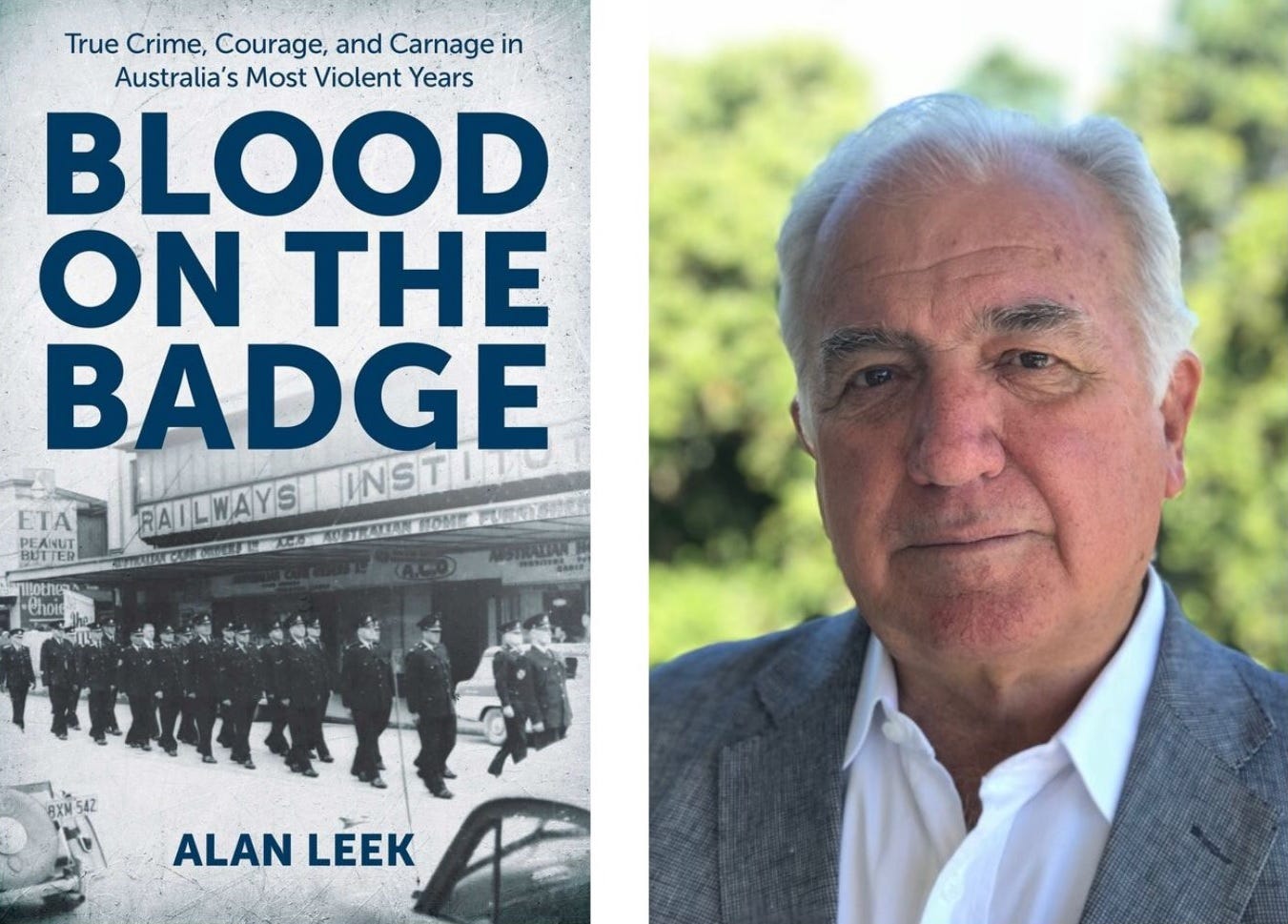
Blood on the Badge: True Crime, Courage, and Carnage in Australia’s Most Violent Years is the latest book from author, Alan Leek. It’s a well-researched tribute to the forgotten heroes of Australian policing. You can read my review here.
It was a pleasure to ask him a few questions. As readers will learn, Alan had a lengthy career with the New South Wales Police Force. He served as a detective, before taking up command positions, ultimately retiring with the rank of superintendent.
He holds an Associate Diploma in Justice Administration, Post Graduate Diploma in Police Management and is a graduate of the FBI National Academy (USA). He also received the prestigious Peter Mitchell Award for outstanding performance of police duty.
Alan has previously released several other nonfiction titles with Big Sky Publishing, such as Rat in the Ranks, Rendezvous with Death and Confronting Murderous Men.
I hope you enjoy this interview and reading Alan’s fascinating insights.
Hi, Alan. For those reading this interview who haven’t read Blood on the Badge, how would you describe it to them?
Alan Leek: I became interested in the war years after writing the biography of Frederick Whirlpool VC and learning of his time in the Tasmania and New South Wales police forces. I knew of the George Cross being posthumously awarded to Blayney constable, Eric George Bailey, and researching that led me to associated matters in New South Wales, some of which revealed myths that had built up around them over time. It became a series of tales of crime and gangsters and the aftermath of their misdeeds.
It also addresses the oft repeated claim of the ‘good old days’. Read this and put paid to that myth. The claim may have been reassuring, but it isn’t true. The times I write about here were bad, hard and mean. I wanted to expose that truth.
You have done a remarkable job uncovering these stories from the past and bringing them to life for a modern audience. Can you tell us about your research process? What does that look like? And how do you decide what stories to include?
AL: For a start, I made it clear that not all deaths of serving police officers would be covered within the time frame I had chosen. Arbitrary decisions were made to exclude some cases as it was not meant to be a catalogue.
The chapters began with what I discovered about the death of Bailey and how he came to be murdered, which had nothing to do with reasons put forward by others over time. His murderer had killed others and he was hiding in Blayney. It ran from there, but there has to be a time when I would not continue as some of the later cases are still raw with families and I wanted to respect that.
My process was based on deep research that aimed at establishing facts at a particular level, firstly at the criminal proof of ‘beyond reasonable doubt’ and if that wasn’t available I would weigh what I had on the balance of probabilities. If I made an assumption, I would say so. I also declined to embroider events to make them sensational. It is not what I want – I don’t write fiction.
I used resources from State Archives NSW, Trove, National Library of Australia and in the later cases from those involved and my own recollections.
I was struck by how many of these police officers were also veterans of World War Two. Do you feel this somehow magnified the tragedy of their losses?
AL: Absolutely. To survive the theatres of war only to be murdered by those who didn’t serve remains a terrible blight on our history. This was not an argument by those who objected on conscience or religious grounds. The killers were those who were deemed unfit to serve because of their criminal activities, or who declined to participate as they eked out an existence at the edges of society. There were others who failed whilst in service who went on the use their new-found killing skills at home.
On the other hand, there were many instances of former servicemen who aided in the protection of their community at home when quick action was required. Others joined the police force when they returned or took up positions they had previously held.
Either way, serving in dangerous times at the front and at home and being murdered in the latter was a sad and profound civil example of double jeopardy.
The book certainly depicts a violent period in Australian history. What factors do you think made this particular era such a violent one?
AL: That is an interesting sociological question. Without going too deep, the simple answer to some extent, must be inequality. The first war followed close on the heels of a serious depression in the late 19th century. When that war ended in a punitive treaty, things were not solved, but adjourned to another time, leading to another conflict. Dissatisfaction, the Great Depression, and World War II brought great loss and privation across the world.
In Australia, political groupings emerged from both conflicts, like the quasi-fascist New Guard of Eric Campbell that gained a membership of hundreds of thousands. Communism became a foil to right-wing movements. The International Workers of the World (IWW or Wobblies) incurred the wrath of governments for their presumed anarchistic tendencies.
All of these had their moment and none of them improved the lot of the average citizen. Capital still reigned and labour was ill-served. Among the disenfranchised were those who sought easier pickings through criminal activity, some of whom where long established and skilled at their particular and sometimes, family undertakings.
After war, the tools to assist the more sinister of these enterprises were readily available in the form of weapons, including machine guns, and munitions. These were readily taken up by the ill-disposed, many of whom imitated Hollywood popular culture figures, right down to the jargon they used. Intelligence rarely came into the equation.
ANZAC Day features prominently in the book. I can’t help noticing the parallels between the bravery and service of our veterans and first responders. Do you think we, as a society, recognise that kind of domestic sacrifice and service in the same way?
AL: No, and I think that’s because of the vast difference in scale of the sacrifices made. We are looking at thousands at home across the nation and hundreds of thousands in world conflict.
Since the conflicts in South Africa - and to a lesser extent, the Maori Wars - through WWI and WWII, Malaya, Korea (itself long neglected) and Vietnam, the scale of those conflicts, and the time that has elapsed since the earlier ones, has allowed for the crafting of epochal histories. All nations do this, as I remark in Frederick Whirlpool VC when referring to the Indian outlook on the conflict.
The service of those in mass conflict is remembered for massive loss, great heroism and in the case of Gallipoli, a gallant loss.
The loss of individual officers or small groups over a very long time cannot raise the same response, and at the end of the day it is not a competition. National Police Remembrance Day is gaining ground in a specific commemoration throughout Australasia. It is important for families to see their fallen have not been forgotten, and for serving police officers to build from the past esprit de corps for the future.
Blood on the Badge is ultimately a story of service and sacrifice. What do those two words mean to you?
AL: Service is so important. I recall studies in psychology that showed aged care patients who were asked to record their life’s work, revelled in the memory of it and benefitted from the exercise. Those who served their community were particularly exercised by having done so and recalling it. It sounds corny to some, but it is an honour to serve in any capacity and the quid pro quo is a quiet satisfaction and self worth.
In some fields, that are obvious, sacrifices are made and I don’t exclude those that aren’t the cause of serious injury or death. Sacrifice is not spoken about in policing, but is omnipresent and quietly expected. Sacrifice is not only made by those who serve, but their partners and family too. As Milton expressed, ‘They also serve who only stand and wait.’ It is why I used his quote as a dedication at the beginning of the book.
While reading, it occurred to me that advancements in technology and procedures could’ve changed the outcomes of certain cases if they happened years later. What do you consider the most effective improvement in policing during your time in the Force?
AL: This is most frustrating when writing crime history. Looking at cases and injuries and knowing that today many victims would have survived and many crimes would have been solved and probably have prevented more from occurring.
Having said that, we still have to view those happenings through the prism of time and place. I have been astounded at the wit, intelligence and capacity of early police to achieve with what they had. Inferior or no firearms, no fingerprints until 1902, no blood grouping, not much photography and little in the way of capable forensics. Those early men were inspiring and did inspire me as a young detective when I perused the Australian Criminal Registers of the old days and saw how they dug deep to stay on top of crime.
I joined the NSW police as a cadet 60 years ago. I can’t believe it yet. As a constable I worked in Sydney, leaving the station to walk a pre-allocated ‘beat’ and was required to call the station from a callbox that were scattered at various locations. I had to call every hour on the hour or on the half hour to ‘get a mark’. It showed that you were still alive and if not, your murderer had an hours head start on investigators. The call box at Wynyard Railway still had a candlestick telephone that connected you to Phillip Street police station by hitting the earpiece rest. No mobile phones, no radios. In fact, most police cars had no radios, or commercial ones to at least listen to the cricket. That’s probably why they weren’t fitted.
If we were required to work overtime we weren’t paid for it. You ask how much has changed and I say – plenty and if only.
Working traffic duties from George Street North often required me to catch a train to Rosehill or Warwick Farm racecourses to get the traffic in and out and to facilitate movement of people. Strange to think I was to work traffic without a car, but there you go. Rosehill was not such a problem because the railway line was close by. Warwick Farm required traffic men to work the traffic points until the last train left the area. Old hands taught me to stop a car to hitchhike to Liverpool to get home. How demeaning? I felt it acutely then. I couldn’t afford a car and am not sure if I would have been allowed to use it on duty anyway. Draconian!
In my period there were many moves, though they were slow. I worked at George Street North police station with a blinker and corded plug switchboard that I eventually mastered without getting yelled at too much. On the upper floor, one had to be careful where you placed a chair as the legs were prone to break through into the station below. I think these things were fixed, but after it ceased to be a police station. I recall some buildings that still had hydraulic elevators where you put your hand into a recess and pulled on a rope to activate the lift.
Police vehicles began to be fitted with radios to connect to the station, police radio branch and other cars. Heaven! Random breath testing was adopted and it, eventually, with other improvements, led to a decline in what was then a massive fatal motor vehicle crash rate. It wasn’t liked, but it saved many lives, and still does.
The largest impact on investigations was DNA, although in the early days it was hard to get permission to use it because of the cost. It has of course, revolutionised policing in the way and more so, than fingerprinting did in the early 20th century.
Even as late as the 1990s criminals had mobile phones, but police didn’t. Cost again – and lost opportunity.
Other technologies, too numerous to go into, have also made massive changes possible. I have often commented publicly that the police force today is much better than the one I joined. Those still serving may not agree, as I believe morale is poor, but results for the public are very impressive and will continue to be as long as police are permitted to focus on core business and not be used as general factotums as was once the case
You left school at fifteen, then worked as a rouseabout in a wool store, before joining the police cadet corps. What made you decide to join?
AL: It could have been worse. The Department of Education vocational guidance counsellor assessed me as being suitable to work as a sewing machine mechanic. I don’t how they arrived at this brainwave as I am a mechanical non-event. And what a growth industry it could have been!
The wool store was readily available and the work quite demanding. One asset was learning to swear like a trooper from the old shearers. I have not lost the ability when needed.
I started work at 15 in 1963 and the wool-classing course took four years at tech, Stage 1 and Stage 2. 1964-1965 saw a strong drought and poor wool was coming in from far afield and a lot of it was dead wool from carcasses or matted with mud from what was left of dams.
The writing was on the wall and I knew I wanted more, but didn’t know what it was. The industry had a habit of taking you on at 14 or 15 until you completed Stage 1 and nearing 17. Seventeen meant a pay rise – and the sack. It was cheaper to put on another younger kid. I was a member of the Storeman and Packers Union whose claim was that they had not called a strike for fifty years. Thanks guys!
I was often asked to leave the tech class for lack of interest and the teacher was sympathetic. I would go to the Newcastle library and read everything that interested me until it was time to catch the bus home, so my parents were none the wiser. I think I learned a lot there.
I had never met a policeman and had no longstanding ambition to join the police. My father ran through a list of jobs I might think about but nothing appealed until he mentioned the police force. It wasn’t the police force that attracted me, as I knew little about it, but freedom beckoned from my over-protective mother who allowed me none. I simply wasn’t allowed to go out or have friends. I suppose it was her way of keeping me out of trouble. It was the same reason she wouldn’t allow my workmates to visit as some were a bit rough. So, here I was in pristine condition and ready for ‘the big smoke’ and the Police Training Centre at Redfern.
What a shock!
You went on to have a remarkable thirty-four-year career with New South Wales Police, Alan. Are there any events or cases that most standout for you during those years, particularly on a personal level?
AL: I’ve never been driven to focus on my own career. I enjoyed it, I did well at it and was recognised for some of it. It provided me with the knowledge that I could be educated, firstly with the difficult detective course, but later at tertiary institutions here and overseas. Deep down I knew I could do better, but the door had to be opened for me to take the plunge.
A serendipitous meeting with a retired teacher in the Blue Mountains, named Bill Black, who I had met as a victim of crime, forced me to apply to Mitchell College of Advanced Education, as he was going to Bathurst and would drop an application in for me. I was trapped - and committed. My ‘Mr Chips’ moment. I’ve never forgotten him and his faith in me. I only met him that once. Mitchell became Charles Sturt University and I revelled in learning. I wondered what might have happened if public education had not been as it was for me, like being made to stand in the corridor for maths lessons as I was incapable of learning it, more so because I wasn’t in the class. A self-fulfilling outcome that I labour with to this day.
I later took part in the Police Executive Development Program, which included a postgraduate diploma at the Macquarie Graduate School of Management. It was drier than sociology and psychology but incredibly valuable for my future career.
My first real moment of satisfaction was being promoted to detective sergeant. I rose steadily - and later rapidly - to superintendent, and was statutorily appointed chief superintendent for a period during the police reform process.
Personal highlights were working as the officer in charge of detective at Blacktown with a great team. Busy places were always the happiest. I later worked as the patrol commander, chief inspector at the challenging Cabramatta patrol - again with a dedicated and hardworking team of good people. It was hard work but the community were fabulous and a great asset to this country, no matter their origins. They were a pleasure to serve.
I became superintendent/patrol commander, Newtown, though my tenure was to be short as I was sent to the US and in particular, to the FBI Academy to study with American and other foreign students in their National Academy program run with the fabulous University of Virginia.
I can’t call them highlights, but my memories, some painful, are of homicides, the Granville Train Disaster, re-opening the Vicki Barton murder inquiry after arresting the murderer for an unrelated crime. He was convicted by others who did a superb job against the odds as I was called to work on the Granville matter.
The Vicky Barton murder and the inquiry into the death of similarly aged Tessie Debrincat, still live with me. Again, I led a terrific team on that latter tragedy.
At Cabramatta, I had the challenge tossed up to maintain order when Cabramatta MP, John Newman was murdered. John was a challenge in life and no less so once he had been savagely killed. Aided by the intrepid and tremendously skilled, then Detective Sergeant Nick Kaldas, progress was made as Nick and his team and my detectives worked in unison. I had moved on as the job continued and the principal, who I also knew, was charged and convicted. Each subsequent trial and inquiry only strengthened the great work Nick and his teams had done. Nick would later become Deputy Commissioner of Police, United Nations investigator into the murder of Lebanese Prime Minister and others, and more recently Royal Commissioner into Veterans Suicides. What an honour to work with good people – all of them.
In more recent times, Australia has sadly continued to experience police officers losing their lives in the line of duty. Do you think policing will always carry these significant risks? Is there anything that can be done, in your opinion, to help mitigate these in future?
AL: Of course it is sad and of course there will be others. Police are at the front line of an adversarial system of criminal justice. There is no other way. The difference between policing and other armed services is that the enemy, in the form of those who might kill you, is generally not readily identifiable. There are no uniforms to identify them and more often than not they have the advantage of surprise. Training and exceptional intelligence being readily available to frontline police is a must and has been improved greatly, and must continue to be.
With the advantage of pre-warning, training kicks in and operational orders come into play. In normal duty, warning signs and safety procedures are taught to all police and they know and understand them well.
Less firearms in the community is a great aim. Why any city dweller needs a firearm in their home defies understanding. If a firearm is held for sport, then like handguns, they should be maintained at the clubhouse. There are many obstacles to the proper care of firearms and the actual need for them. Machismo must play a part, but can’t be tolerated.
The thing that should never be forgotten is that the frontline police officer, unlike other armed services is never off duty, never away from the front line and is never withdrawn from it. They and their families face it every day and every night. More often than not their term on active service exceeds 25 years or more. Something to think about. It had its deleterious effects for many.
A younger cousin of mine recently graduated from the Police Academy. What advice would you have for young people wanting to join the Force today?
AL: I too have a younger cousin – three times removed, who has not long graduated from the Victoria Police Academy. My advice to him, once the decision is made to join, is to do your duty with passion, intelligence, fairness, patience and understanding. I might not have remembered it correctly but he tells me he has written my advice into his notebook. Made me feel proud of him.
I can’t advise those wanting to join the police as they have already made the leap, I suppose. Just remember why you are there and remember those who have forged a way for you, some of them at great cost. It is a very worthwhile profession, not without its challenges and difficulties. I would urge them to remember that the office they hold is that of ‘constable,’ an ancient role, the power of which is ill defined, but supported by law. The office of constable is incredibly important. Rank is another matter, determined by experience, achievement and the need to identify the chain of command, so important in an armed service. Higher ranks carry all that and more in management terms and leadership. Let no-one undermine your position. No matter your rank you will proudly retire as a constable of police, a worthy legacy.
Do you have any plans for your next book? What can we expect from you in future?
AL: Readers may not be aware that Blood on the Badge is a revised version of The Killing Chronicle - it allowed me to correct previous errors and to expand information, as people contacted me regarding some aspects, like Alfred Gregory’s Aboriginality - which I didn’t know about when writing. It explained his close friendship with my predecessor at Cabramatta, Bill Espie, who was an Arrernte man. He was the most senior ranked Aboriginal man in any armed service in Australia.
I have just finished the first draft of my next book, dealing with some historic and awful murders not widely known or remembered. I start in 1859 Tasmania, and work my way through SA, Vic, NSW and NT. It features only one police killing, Inspector Richard Palmer Pettinger, who was shot in Government House, Adelaide in 1862. I’ve avoided all mention of bushrangers and the regulars who are trotted out and done to death. It will be my sixth stand alone title. Blood on the Badge and the hardcover Frederick Whirlpool VC, for which the world rights were sold to a UK/USA publisher after the Australian paperback release, will make eight at a pinch. And I’m not finished yet. The first book I wanted to write has not been done as I got distracted with Whirlpool. I doubt it will be written, but I have some other ideas, none of which, like the others, I ever set out to write. Funny where curiosity takes you.
I appreciate you answering these questions, Alan, and sharing your insights with us. Thank you for your service.
AL: I have to say that this is the second time I have ever been thanked for my service. The first was in a podcast I did a year ago when a former NZ officer did the same. It floored me and made me realise that it had never happened before. Many thanks!